
Location : Home page / History /
HISTORY

A LONG HISTORY SINCE 1796 …

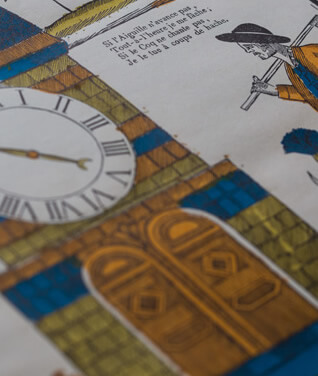
Jean-Charles Pellerin, card maker and woodcutter in Epinal at the end of the XVIII century, made card games and prints. His presence in the area is due to a privilege accorded to Epinal and to Nancy who were the only towns in Lorraine in the XVI century who were permitted to accommodate master card-makers. Until the years 1800-1810 he printed cards and religious images. Little by little, more and more genre work was produced in addition to the fine prints, and religious images seemed to make way for products illustrating popular events.

It was illustration which, in the name of engravers like Réveillé and Georgin, allowed Jean-Charles Pellerin to cement his fame, the Napoleonic saga doing the rest. In fact the First French Empire provided engravers with very varied themes that were very influential on public opinion. It was possible at that time to buy a battle scene or a portrait of the Emperor from peddlers, engraved on wood with a special “sparing” technique, then coloured with stencils. Despite the restoration of the monarchy and as a consequence of censorship, the series of imperial prints assured the prosperity of the Pellerin studio.

In 1822, Jean-Charles’ son Nicolas Pellerin (29 years old) and Pierre-Germain Vadet, his brother in law, took over the business. At this time the manufacture of cards definitively replaced that of images. The Imagerie d’Épinal was growing. Between 1832 and 1846, 40 workers were taken on and Pellerin images were distributed around the world. On 30 October 1858 the company was formed under the collective name "Pellerin and Company" with Nicolas Pellerin, Charles Pellerin, his son, born in 1827, Pierre-Germain Vadet, son in law of Nicolas Perrin, and Léon-Joseph Letourneur-Dubreuil, son in law of Pierre-Germain Vadet.

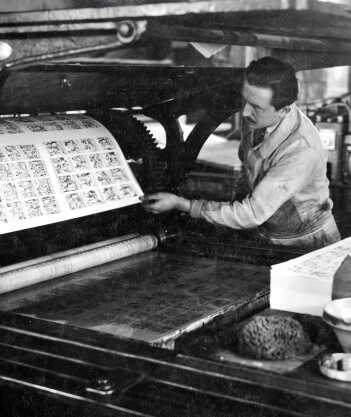
Successive company administrators competed in developing new techniques. After woodcuts, it was moulding, lithography (used exclusively from 1854 to 1855) and colour lithography which appeared in workshops. Production evolved: image-illustration turned into simple images. At the time of re-editing the Bibliothèque bleue, large format woodcuts were made, each containing 12 or 16 vignettes. The drawings were done by professional artists such as Charles Pinot before 1860 and Legros, Phosty and Chaffour in the 1890s… The Parisian artists ended up having a good knowledge of the needs of the image industry from the Vosges region and several of them offered their services, however, like Pinot, they soon found Pellerin to be less than happy with this and stopped.

In 1860 Charles Pinot, whose artistic talents were instrumental to the commercial expansion of the 1850s, left Pellerin with several other employees to set up his own company – Ch. Pinot et Sagaire. That same year Charles Pellerin built a department store on rue Leopold-Bourg and a four floor building to house the company in Place du Quartier. Probably due to the competition from Pinot, the Imagerie Pellerin multiplied its contacts and orders with Parisian artists, as much for simple woodcuts as for advertising creations. The sale of Epinal images was done through peddlers, bookshops and overseas representatives.

Peddling was the means most often used. For Epinal images most of the peddlers came from only one village : Chamagne, Vosges. This is where they got their name "chamagnons". Peddlers went from village to village with a hotte (a sort of small cupboard with two doors) on their back and sometimes with a donkey that carried the merchandise. They stopped in the village square, sang a lament and set out their wares : brochures, images, newspapers, rosaries, medals, dry goods… Very often, they bartered and exchanged goods for rags for the paper making industry or rabbit skins for making felt hats. The multicoloured Pellerin images sold well, as did the Bibliothèque bleue brochures, and almanacs. The peddlers did not have a monopoly on the sale of Pellerin images though - the 1842 catalogue states the terms and conditions for sales in bookshops. Épinal Images’ success moved beyond the borders of France and meant that Pellerin had to translate his texts into languages other than French : bilingual images for Germany and images destined for export written entirely in another language and distributed by foreign representatives.

At the end of the 1880s, Pellerin decided to give the benefit of his experience as a colour printer to Gaston Lucq, known as Glucq, a Parisian draughtsman. This association probably helped Pellerin to overcome the events of 1888 : the fire in the colour workshops, then the buyout of the competitor company Olivier-Pinot. After the death of Pierre-Germain Vadet (1870), the departure of Léon-Joseph Letourneur-Dubreuil (1880), the death of Charles Pellerin (1887) and the purchase of the House of Pinot by Mrs Olivier, the company found itself officially administrated by Georges Pellerin, son of Charles, who was born in 1852, and Pol Charles Marie Payonne, husband of his sister Marie-Louise.

The Third Republic saw the appearance of legendary portraits of important historical figures and descriptions of major political events: the war of 1870, the Commune. Thus Pellerin Images was distinguished by a certain political and moral commitment and came to be a symbol of values. From 1880 to 1896, Épinal, capital of the popular image, adapted its images to fit the scientific “current affairs” of the age - in full industrialisation. The originality of Glucq’s encyclopaedic series ‘Illustrated Lessons’ was to bring a totally new aspect to these iconographic themes, previously restricted to history, religion and to fairy tales. They were born out of the association with the Imagerie Pellerin and the publisher/publicist Glucq. The idea of Glucq and the image-maker was to replace the hero of stories told in images by "products for consumption", thus responding in a simple and efficient way to the curiosity of the common people and the bourgeoisie, who were fascinated by industrialisation. School having been obligatory since 1882 and physical and natural sciences having been introduced in the name of "Lessons on objects" in primary education, the theme of linked images in a volume of 50 leaves on the observation of objects or nature associated with scientific discoveries and their applications : the history of fire, glass, gas, sugar… But these images will always have an advertising aspect and despite the enthusiasm of primary teachers, the government did not encourage the enterprise. The cost of the project did not bring the expected success and in 1896, Glucq had to give up his share of the Imagerie Pellerin, which removed all advertising references from their iconography and updated and modernised it. The new production of 1905 was entitled "The Glucq Encyclopaedic Series and Lessons on illustrated objects". After the First World War the series did not change a great deal and simply ran out of steam.

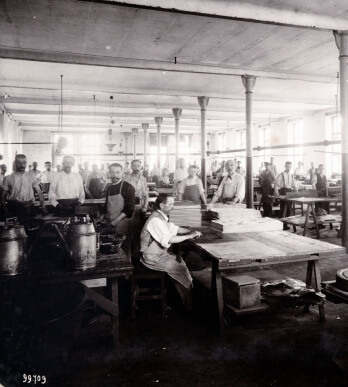
On 29 March 1895 the status of the company were modified to allow the admission of a co-associate Hubert Gourier, husband of the second sister of Georges Pellerin. Until the onset of the Second World War, the Imagerie, in its new location on quai de Dogneville in Epinal (built between 1896 and 1897 and still occupied by the company), developed its history series and its construction games. Alongside its creative activities, Pellerin consolidated his position of an advertising printer with bookshops and small businesses. The reverse side of these images was printed with a text written by the customer. The Great War caused the partial closure of the factory but in spite of this Georges Pellerin honoured orders from Switzerland or Algeria. As in 1870, the Imagerie participated in the conflict by distributing "anti-boche" images.

When Georges Pellerin died in 1918, the company found itself managed by Pol-Charles-Marie Payonne, Maurice and Émile, their sons Hubert and Jean Gourier and Élisabeth Dumont, née Gourier. On 18 décembre 1920, the company took the name "Payonne, Gourier & Company, formerly known as Pellerin". On 14 May 1921, Hubert Gourier conceded 1/250 of the capital to Max Prud’homme, husband of the daughter of Pauline Vadet and of Léon Letourneur-Debreuil. Pol Payonne disappeared and on 1st June 1921 the "Imagerie Pellerin S. A." was born. In the 1920s, business activity started up again: the House created albums-toile for children, but competition increased in the bookshop and Imagerie sector. Attempts were made to revive business relationships from the start of the century between imagiers: Vagné and Son in Pont-à-Mousson ; Alfred Delhalt in Nancy ; Alexandre Capendu, a Parisian publisher and agent. It was thought to sue German publishers. Hubert Gourier died in 1934 and left the company to his nephews Maurice and Émile Payonne.

The Second World War again interrupted activities at the Imagerie, which started up again with difficulties in the 1950s. The weekly children’s comics as well as publishers like Hachette were publishing articles which pleased customers more. The company was administered by René Simon, grandson of Hubert Gourier, on the retirement of the Payonne brothers in 1954. At the start of the 1980s the Imagerie grew in media terms due to publishing artists as well known as Tardi or Fred, and benefitted from daily television exposure on the programme "Récré A2" on the French TV channel Antenne 2. However the company fared worse and worse financially and the descendants of the founder Jean-Charles Pellerin were forced to file for bankruptcy.

In 1984 five young Industry leaders and a group of 50 investors from the Vosges region decided to to bring about the rebirth of the Imagerie’s heritage, so dear to the local people. Eric Staub, one of the young entrepreneurs, was named CEO. He immediately lead the company in a fair and economical way, faithfully preserving the identity of the House and the colours of the stencils and adapted these creations to modern printing techniques. From 1989 the Imagerie d’Epinal went back to its roots in graphic and artistic expression relevant to its era and collaborated firstly with the artist Antonio Gacia, then with others such as Jean-Paul Marchal, Isabel Yung, Clair Arthur, Guillaume Roussel, Olivier Claudon, Patrick France, Sidonie Hollard, Thierry Desailly and Anne Logeais.

At the start of the XXI century the Imagerie d’Épinal is developing three main activities: publishing Épinal images, often related to current affairs ; the artistic workshop which welcomes more than 200,000 visitors per year, and the creation of Épinal images for companies or institutions for special occasions. Despite the fact that society in general is looking towards better performing means of communication, Épinal images still have a special place in the world.

HISTORICAL ARCHIVES

Around 500m long, the archives of the Imagerie Pellerin of Épinal have been confirmed by an official contract registered in the Vosges area archives (General Council of Vosges) in 1988 and classed as a Historical Archive in 1989.

It is made up of the following types of documents:
  • company management archives on accountancy, HR, supplier relations, documents relating to legal preparations and company materials;
  • archives relating to artistic creation such as artist correspondence, original drawings, tests submitted as copies ready for printing, colour tests, giving up of author’s rights,
  • old printed images (almost 40,000), to compare to the original drawings, with the evolution of printing techniques used at the Imagerie and with the research of new aids,
  • a collection of documents consisting of printed works on printing techniques or business or legal activities, works or catalogues produced by competitors, books given as personal gifts to the administrators of the Imagerie Pellerin and works published by the Pellerin house itself.

As for the 48J, the Pellerin archive collection was the object of a scientific inventory, published with the Direction des Archives de France in July 2009. The old images benefitted from the systematic and progressive digitisation by the laboratory for the digitisation of the Archives of the Vosges area, with the objective of rendering the totality of the historical collection consultable on computer terminals. This is to preserve the originals from direct handling. Each image is the object of a descriptive file and a digital image, associated to a document database with visualisation.
Consult the inventory of the collection at www.vosges-archives.com, section « Consulter les fonds » (Consult the collection), then « Etat général des fonds » (….), then « Archives privées » (Private archives).

How was the Archives de l’Imagerie Pellerin d’Epinal 48 J collection constituted?

In 1980, the Pellerin company encountered serious financial difficulties and organised a public sale of images and printing apparatus which made waves but did not make a massive impact financially. Entrepreneurs from the local area got together to take it up again in 1984. On this occasion the new company Imagerie d’Épinal S.A became the owner of the archives, stored in factory buildings built in 1897. Rapidly, it appeared that these buildings were not suitable for storing archives as they had been rendered unusable due to their deterioration. To protect and safeguard them the Imagerie d’Épinal S.A put into the Archives départementales des Vosges on 23 June 1988 a historical collection of archives and images 500m long, covering the years 1779 to 1984. This bailment was updated in 2003 and co-authorised by the Head of the Board of Directors, the CEO of Imagerie Epinal SA, the region of Vosges and the director of Archives de France, to respond to the use of new technology in the treatment and distribution of iconographic collection documents.

The historical collection, composed mainly of administrative and commercial archives and image production from the Pellerin and Olivier-Pinot houses, was classed as a historical archive by ministerial decree on 4 April 1989. This resolution was part of the general measures to protect the heritage of the Imagerie and followed the classification of the Imagerie building as a listed building, along with the printing machines in April 1987. The link between the conservation of the collections and their use was cemented by an special tripartite loan agreement established on 19 April 1997 between the Imagerie d’Epinal and the General Council of Vosges (area archives of Vosges), as an agent, and the Image Museum, using potential and privileged collections. The campaign to protect the heritage was extended in 2006 by entry in the Supplementary inventory of Historic Monuments, the conservation phase before classification as a listed building or object, of lithographic stones, zinc plaques, small items and vestiges of furniture from the Pellerin house from the start of the XIX century.

What is the importance of the 48J collection of the Imagerie Pellerin Archives in Epinal?

The historical importance of the Imagerie d’Epinal SA is due to its familial, artisanal and artistic character, whilst maintaining its business aspect. Through this, the influence of the Imagerie Pellerin has been felt in Vosges, in the Lorraine region, in France and beyond France, and the evolution of the themes illustrated.
The production of the Imagerie differs from that of other companies of an industrial bent because it’s founded on the creation. It’s also a history of a signifier - the image - of its evolution for more than two centuries, of the religious image in commercial materials, of the educational image for genre scenes, finally for its progressive use in the media, support for moral values, for advertising and more generally for advertising use. It’s also the history of a cultural milestone: the culture and the French language have integrated the notion of the Epinal image, a product with strong moral values and representing a caricature of the world and which in modern language has become a synonym for the notion of simplicity. Lastly, it’s the story of a commercial enterprise trading on the national and international markets.
The commercial archives form the major part of the collection of the Imagerie Pellerin of Epinal and allows the researcher to follow their business evolution or their modes of representation. The series of pieces of correspondence of the Pellerin company with their partners, customers, their suppliers, and their artists, covering more than a century, are exceptional. The richness of the order files, made by clients, companies, merchants, individuals, associations and by bookshops and stationers trustees also necessitated the constitution of an index, published at the end of the 2009 inventory, in order to take into account the extraordinary scope of the company. What is also remarkable are the testimonies of the management of the personnel, employees and staff of the Imagerie over more than a century: workers in local manufacturing industries and associated artists, commercial agents and exclusive representatives in France and the world.

How can I consult the 48 J collection?

The collection can be consulted at the Archives départementales des Vosges, 4 avenue Pierre Blanck, 88 000 Epinal, France. This is open from Monday to Friday from 8.30am to 5.30pm and Saturday from 8.30am to 12.30pm. Visiting information is at www.vosges-archives.com.
According to the security deposit agreement, revised in 2003 (art. 3), the collection is able to be consulted only with the authorisation of the company representative. The use of iconographic documents is subject to the measures of the ‘Code of intellectual and artistic property for the reproduction of images or archive documents’ and a written request to Imagerie d’Épinal S.A. (article 4 of the revised contract) must be made, in order to protect the commercial interests of the company.
The 48 J collection registered by Imagerie d’Épinal S.A. must not be confused with the Archives départementales des Vosges, two complementary image collections, 8 T and 18 Fi. In 1996 at the preliminary sorting of the transfer of the collection of popular images of the Regional Museum of ancient and contemporary art at the Museum of the Image, close to 3000 images from the registration of copyright and therefore the public archives which were registered at the Regional Museum in 1937 ; this collection was officially recorded at the Regional Archives, in order to complete the 8 T collection for the monitoring of the council on the Vosges printing press (1800-1940). The sub-series 18 Fi is an open collection composed of Epinal images entered into the Regional archives through purchases and gifts.

TECHNICAL HERITAGE

Manual diagraph
3rd quarter of the XIX century
Classified as a historical artefact on 15/04/1987

Punching Machine
E. Houpied, manufacturer
1st half XX century
Classified as a historical artefact on 15/04/1987

Punching Machine
Arthur Mulcer, manufacturer
1st half XX century
Classified as a historical artefact on 15/04/1987

Binding press
Coisne, manufacturer
1st half XIX century
Classified as a historical artefact on 15/04/1987

Binding press
Coisne, manufacturer
1st half XIX century
Classified as a historical artefact on 15/04/1987

Binding press
Aimé Morane, manufacturer
Middle XIX century
Classified as a historical artefact 15/04/1987

Paper cutter
Poirier, manufacturer
End XIX- start XXe century
Classified as a historical artefact 15/04/1987

Paper cutter
Karl Krause, manufacturer
End of XIX- start XX century
Classified as a historical artefact 15/04/1987

Jigsaw
Tiersot, manufacturer
1st quarter XX century
Classified 15/04/1987

Jigsaw
Tiersot, manufacturer
1st quarter XX century
Classified 15/04/1987

Jigsaw
1st quarter XX century
Classified 15/04/1987

Rounding machine
Karl Krause, manufacturer
4th quarter of XIX century
Classified 15/04/1987

Colouring machine
SACM, manufacturer
1st quarter of XX century
Classified 15/04/1987
Stencil colouring machine
SACM, manufacturer
1st quarter of XX century
Classified 15/04/1987

Stencil colouring machine
SACM, manufacturer
1st quarter XX century
Classified 15/04/1987

Manual letterpress printing machine
Dingler-Sche, manufacturer
1st quarter XIX century
Classified 15/04/1987

Manual letterpress printing machine
Dingler-Sche, manufacturer
2nd quarter XIX century
Classified 15/04/1987

Mechanical Victoria letterpress printing machine
Rochstron and Schneider-Nachf, manufacturers
4th quarter XIX century
Classified 15/04/1987

Mechanical Perfection letterpress printing machine
P. Capdevielle, manufacturer
2nd quarter XIX century
Classified as a historical artefact 15/04/1987

Flat lithographic press
J. Busser, manufacturer
4th quarter XIX century
Classed as a historical artefact 15/04/1987

Flat lithographic press
J. Busser, manufacturer
4th quarter XIX century
Classed as a historical artefact 15/04/1987

Flat lithographic press
J. Busser, manufacturer
Middle XIX century
Classed as a historical artefact 15/04/1987

Electric plate grinding machine
Lilliput, manufacturer
2nd quarter of XX century
Classed as a historical artefact 15/04/1987

Clock case
Painted wood
XVIII century
Entered in the supplementary inventory of historical artefacts on 19/12/2005

Wardrobe with two doors
Oak, Lorraine
XIX century
Entered in the supplementary inventory of historical artefacts on 19/12/2005

Wardrobe with two doors and two drawers
Oak
XIX century
Entered in the supplementary inventory of historical artefacts on 19/12/2005

6 897 lithographic stones (printing elements)
Oolitic limestone
1850-1900
Entered in the supplementary inventory of historical artefacts on 31/05/2007

3 ink rollers
Wood and leather, Charles Schmaltz (Paris)
XIX century
Entered in the supplementary inventory of historical artefacts on 31/05/2007

2 inking tables
Wood, Sandstone
XIX century

Entered in the supplementary inventory of historical artefacts on 31/05/2007

Screed work table
9 sleepers, 1 funnel, 1 tank for powdered limestone, wood
XIX century
Entered in the supplementary inventory of historical artefacts on 31/05/2007

2 screed millstones
37 holes with pivot, steel, wood, stone
XIX century
Entered in the supplementary inventory of historical artefacts on 31/05/2007

Box of 150 pumice stones
Straw, wood, igenous rock, Schumacher (Germany)
XIX century
Entered in the supplementary inventory of historical artefacts on 31/05/2007

Drawing table
Adjustable plate and accessories (angle bracket, t-shaped, removable stand), wood, metal
XIX century
Entered in the supplementary inventory of historical artefacts on 31/05/2007

Rack for lithographic stones
10 slats, wood, metal
XIX century
Entered in the supplementary inventory of historical artefacts on 31/05/2007

2 printer’s devils
Wood, metal
XIX-XX century
Entered in the supplementary inventory of historical artefacts on 31/05/2007

Trolley for printing stones, on rails
Cast iron, wood
XIX century
Entered in the supplementary inventory of historical artefacts on 31/05/2007

Stretcher for printing stones
4 sleepers and wooden arms, 2 sleepers and metal braces
XIX century
Entered in the supplementary inventory of historical artefacts on 31/05/2007